

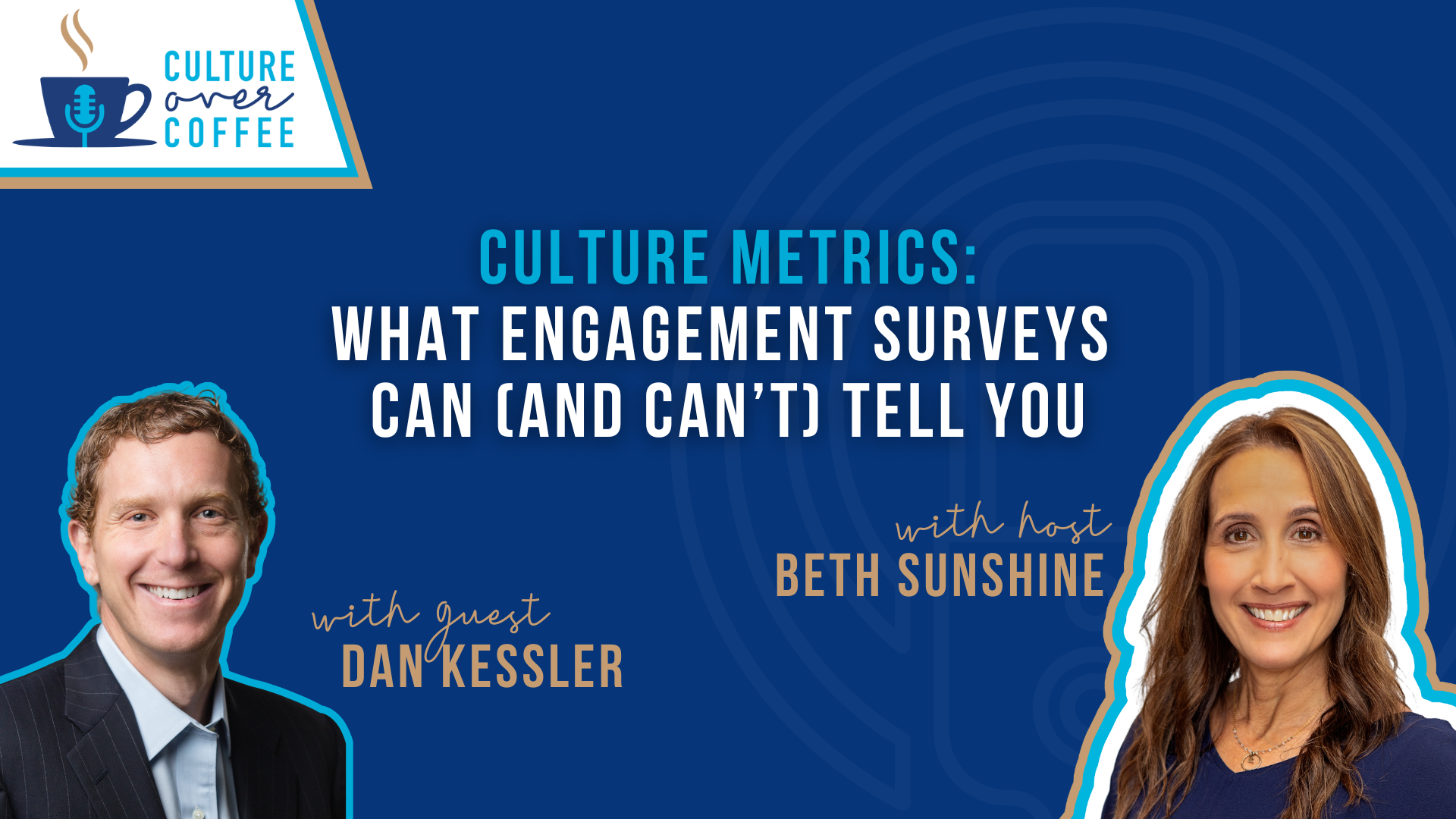


In this episode, Dan Kessler, President of Energage, joins Beth Sunshine to explore how data and action come together to create thriving workplace cultures.
Drawing on insights from millions of employee surveys and thousands of companies, Dan shares how organizations can move beyond measuring engagement to activating it.
Dan has some amazing takeaways, like:
- Why employee engagement data reveals what leaders can’t always see (and how assumptions can quietly derail culture).
- Why “survey fatigue” isn’t real (it’s actually inaction fatigue) and how authentic follow-through restores trust.
- And, finally, how middle managers, often caught between leadership and employees, play a pivotal role in turning insights into cultural momentum.
How Can Leaders Turn Employee Engagement Data Into Real Culture Change?
The short answer: Employee engagement surveys only create value when leaders move beyond measurement and use the data to spark focused action, honest conversation, and consistent follow-through.
As Dan says in the episode:
Culture doesn’t change because you measured it.
Culture changes because people act on what the data reveals.
Why Measuring Employee Engagement Matters More Than Leaders Think
Employee engagement data surfaces what leaders can’t see in day-to-day interactions.
Many leaders believe they already “know how people feel” because they walk the halls, host town halls, or manage by Zoom. But as Dan noted, once you become a leader, your jokes get funnier and your ideas sound better (whether you intend that or not.
Surveys create psychological safety by giving employees a trusted way to share what they really think, not just what feels safe to say out loud.
What engagement data reveals:
-
Hidden friction in manager/employee relationships
-
Misalignment between leadership intent and employee experience
-
Early warning signs of disengagement and turnover risk
At Up Your Culture, we often see leaders surprised, not because they don’t care, but because assumptions quietly filled the gaps where data was missing.
What Leaders Are Actually Measuring (And Why It Matters)
Dan outlined three core lenses that shape engagement and organizational climate:
1. The Individual Experience
Pay, benefits, workload, flexibility, and growth opportunities.
2. The Manager Relationship
Recognition, inclusion, openness to ideas, coaching, and day-to-day support.
3. Senior Leadership & Direction
Trust in leadership, clarity of vision, values, communication, and how work gets done across teams.
Together, these drivers shape engagement outcomes like motivation, loyalty, and willingness to recommend the organization (often measured through Employee Net Promoter Score [eNPS]).
The Biggest Misconception: “We Have Survey Fatigue”
According to Dan, survey fatigue isn’t real... inaction fatigue is.
Employees don’t expect leaders to fix everything. They do expect:
-
Acknowledgment of their feedback
-
Clear priorities
-
Visible progress and communication
When leaders choose one to three meaningful focus areas and talk openly about what they’re doing, trust grows and engagement rises across the board.
How to Move From Data Collection to Culture Activation
Engagement surveys shouldn’t live as HR artifacts or annual report cards. They work best when treated as a business strategy tool.
Step-by-step:
-
Thank employees for their feedback (immediately)
-
Select 1–3 priorities tied directly to survey insights
-
Explain why those priorities matter
-
Equip leaders and managers to act
-
Communicate progress consistently (“Here’s what we heard. Here’s what we’re doing.”)
As Dan shared, organizations that connect human capital data to business outcomes consistently outperform the market, proof that culture is a competitive advantage, not a soft metric.
Why Middle Managers Are the Culture Linchpin
One of the most striking patterns in engagement data?
Middle managers are often the most isolated, overwhelmed, and under-supported group.
They sit between executive expectations and employee needs, responsible for translating strategy into daily experience.
What helps middle managers succeed:
-
Clear direction from leadership
-
Permission to discuss tough feedback openly
-
Coaching and development support
-
Ongoing communication up and down
Data points the way, but people (especially managers) do the work of culture change.
The Role of Qualitative Feedback (The “Color” Behind the Numbers)
Quantitative data provides structure. Qualitative comments bring meaning.
Modern engagement tools now adapt follow-up questions based on employee responses, helping leaders understand why scores look the way they do. With AI-powered theme analysis, patterns emerge that turn feedback into actionable insight.
As Beth shared during the episode:
The data is the skeleton. The comments are the color that bring it to life.
Trends Shaping Employee Engagement Right Now
Dan highlighted several shifts leaders should be paying attention to:
-
Flexibility over fixed models in remote and hybrid work
-
Employer brand and internal culture converging
-
HR and marketing increasingly aligned around authentic employee voice
Candidates are paying closer attention to culture than ever. Organizations that align internal reality with external messaging build trust and attract stronger talent.
Why Data + Coaching Works Better Together
While some organizations can act on engagement data alone, most benefit from an external partner who can:
-
Serve as a trusted advisor
-
Facilitate difficult conversations
-
Provide accountability and momentum
-
Help leaders translate insight into action
That’s why the partnership between Energage’s data and Up Your Culture’s coaching and activation model is so powerful. Data shows where to go, coaching helps leaders get there.
Frequently Asked Questions
Q1: Do engagement surveys really improve culture?
Yes, when leaders act on the results and communicate consistently.
Q2: How many priorities should leaders focus on?
One to three. Focus beats overload.
Q3: Is low participation a sign of survey fatigue?
Usually not. It’s more often a sign that employees haven’t seen meaningful action before.
Q4: Can AI replace human judgment in engagement work?
AI enhances analysis, but culture still depends on human conversations, trust, and leadership behavior.
A Final Thought for Leaders
Culture work isn’t about grand gestures.
It’s about consistent, authentic effort (guided by genuine employee voice).
If you’re ready to move beyond measurement and start activating your culture, the data you already have may be the best place to begin.
Want to explore what your culture data is really telling you?
When you have two minutes, take our Quick Culture Assessment to get a high level view of where your culture currently stands.

Leave a Comment